Optimal tuning of classical guitar
part 1: tuning strings
by Dr Tom Chalko
Have you noticed that your guitar is "out of tune" at some higher fingerboard positions, even if all strings seem in tune in lower positions?
The single most important property of a musical instrument is an ability to tune it.
If an instrument cannot be tuned perfectly, it becomes an expensive piece of woodwork that does not deserve to be called a "musical instrument".
My approach to this problem in the past was to aim for a "tuning compromise" so that all notes on the fingerboard were "equally badly off".
Eventually I decided to implement a method of achieving perfect tempered scale tuning by means of optimizing the bridge support point for each string individually.
In theory, the XII fret should be exactly in the middle of the string. However, when the string is pushed towards the fingerboard, the tension in the string increases and this (of course) changes the pitch.
This change of pitch is different for each string in a set due to differences in string tensile stiffness. G3 string is typically the stiffest and produces the largest pitch changes.
My method of finding the optimal string support point on the guitar bridge relies on matching the pitch of the 1-st octave (half-string) harmonic with the pitch of the string when pressed down in XII position.
If they are matched, and fingerboard is of a reasonable quality, all notes played on this string anywhere on the fingerboard are tuned in the best way possible along the tempered scale.
Optimal bridge support point can be different not only for each string in a set, but also can depend on a choice of strings and their tension ratings.
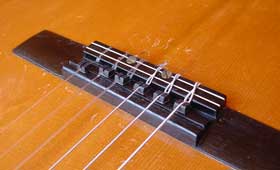
Fig. 1 depicts an "adjustable" solution. It implements 6 tiny ebony blocks, each with a slot for a string. To prevent these tiny blocks from moving around on a slippery surface of the bridge I equipped the bottom of each block with a layer of 1200 grit sandpaper, by gluing the sandpaper with an epoxy resin.
As you can see in the Fig 1. every string is supported at a different length and none of the supports are where the instrument maker (Rudolf Klier of Erlbach, Saxony, Germany) designed them in 1975...
For the first time since I acquired the guitar from Rudolf Klier in 1975 I was able to tune it perfectly and confirm the tuning precision with a spectrum analyzer.
I was greatly surprised how much this perfect tuning increased my joy of playing. All octaves and cords became perfectly tuned, up to XIX position...
After playing with the adjustable bridge tuning system shown in Fig 1. for a while I noticed that positions of bridge blocks changed very little and decided to make a permanent bridge bone, depicted in Fig 2.
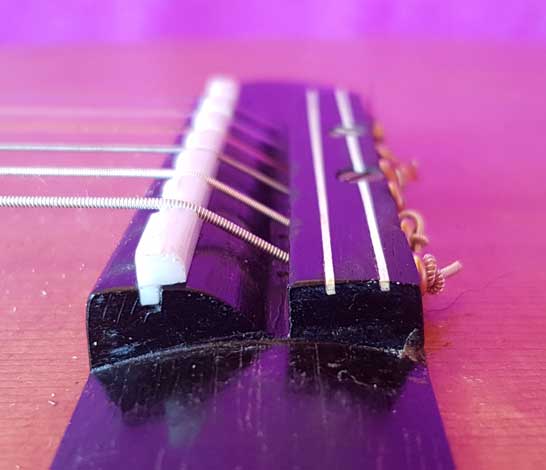
Precisely fitted one-piece bridge bone provides maximally stiff connection between strings and guitar top to improve transmission of vibrations from string to the guitar top. This strategy improves guitar sound quality and volume. The most noticeable effect of perfect tuning was the improvement in the ability of guitar to sustain sound.
The theory of this effect is quite simple: when notes in chords are in tune, harmonics from plucked strings resonate with harmonics on other strings, maximizing the sound energy and sound amplification. In contrast, when notes in cords are out-of-perfect-tune, even very little, the opposite effect takes place: harmonics from different strings disturb (interfere with) one another, reducing the sound energy projected by guitar. The only shortcoming of custom-fitted bridge bone is that it needs to be precisely manufactured using specially designed machine tools followed by laborious manual adjustments.
But the result is really worth the effort.
I have implemented the fixed bridge bone solution to 4 guitars that I own and results are quite remarkable. Guitars came to life... Another technique that I use to optimize guitar sound is "string-load-balancing".